Trees Hate You Trap Encyclopedia
A Trees Hate You trap is almost never a single prop. It's a family — a shape tykenn repeats with slight changes so the joke hits again even after you've learned the last one. Fake Signs aren't one signpost, they're every signpost that leans too helpfully. Hidden Pits aren't one gap, they're every stretch of ground that looks softer than the physics say it should. This encyclopedia breaks each family into the three things you actually need to survive it: the setup that sells you on the bait, the failure read that reveals the joke a half-second too late, and the safe route the forest will let you take if you slow down. Our Trees Hate You trap encyclopedia is the biggest reason this fan site exists — no other page on the search results does this work.
How to read a Trees Hate You trap
Every Trees Hate You trap splits cleanly into three beats. First, the joke-setup: how the trap presents itself from the player point of view. It looks safe, inviting, or obviously signposted — the forest wants your brain to relax before it lands the punchline. Second, the failure read: the subtle tell the animation, audio, or level geometry gives off a beat before the hit. Once you name the read, the same trap in a new outfit reads on sight. Third, the safe route: the actual path, angle, or timing that gets you through. Sometimes it's a step-around, sometimes it's holding still, sometimes it's committing harder than the setup suggests. Read the trap before you walk it. That's the whole game. Every section below follows the same three beats so you can scan for the one you need, not re-read the whole page.
Trees Hate You trap families at a glance
Trees Hate You trap families are clusters of related traps that share a common joke-setup, failure-read, and safe-route shape. Demo v17 ships three: Fake Signs (the forest pretends to help you), Hidden Pits (the ground pretends to be solid), and Red-Leaf Warnings (the warning is real but the safer-looking alternative is the actual trap). Each family contains 4-7 variants with the same shape remixed across terrain. Once you can name the family on sight, you've solved most of the run — Trees Hate You is built around recognition, not memorization. The Steam 2026 release is expected to add at least two new families.
Trees Hate You traps: Fake Signs
Setup
Fake Signs are the Trees Hate You trap family that teaches you the site's whole rule: a readable prop is still a prop. The Steam screenshots make the trick painfully concrete. One frame puts the player in a clearing full of wooden boards, red X marks, axe icons, and repeated direction hints; another shows a big dialogue board saying Watch out. while the character is already down beside the path. That is the joke. The sign may be true, false, late, or only half useful, but it always steals your eyes from the rest of the room. In a normal platformer, a sign compresses the decision for you. In Trees Hate You, it creates the decision you still have to verify. The mistake is not reading the sign. The mistake is letting the sign be the only thing you read.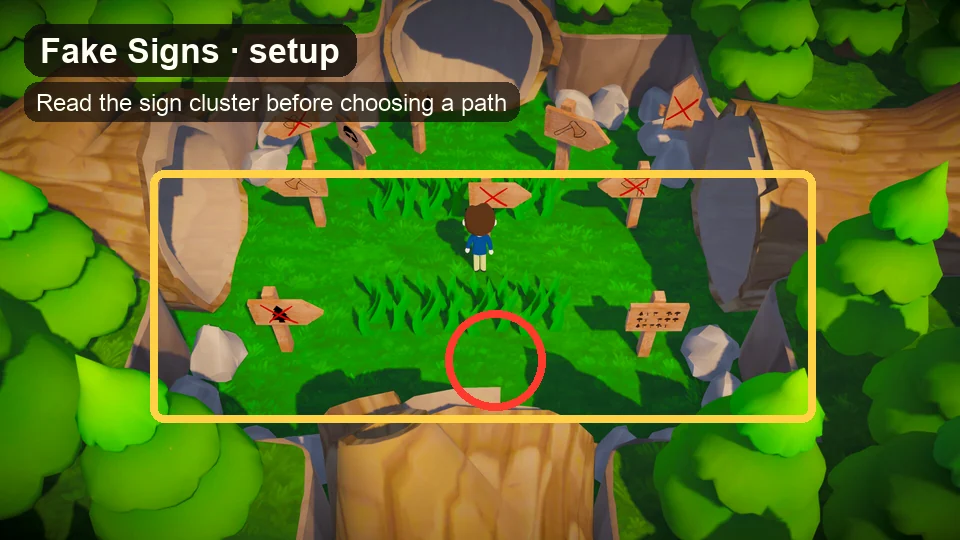 Source frame: official Steam screenshot.
Failure read
The failure read is attention, not text. If the board makes you stop on the exact tile in front of it, the forest has already moved first. If the arrow points at a clean path and you run because the path looks deliberately framed, you have accepted the sign's camera angle instead of the room's geometry. Look around the board before you obey it: where can a tree swing from, which fence edge gives you no recovery space, and which patch of grass is only there to make the longer route look ugly? Creator thumbnails from Ryoshii and GlassBottleGames keep showing the same beat from different angles: the player is looking at the obvious message while the actual hit comes from the side, behind the sign, or just after the sign has made the player relax. A Trees Hate You Fake Sign can even be honest. "Watch out" is useful information, but it is useless if you read it while standing in the hitbox.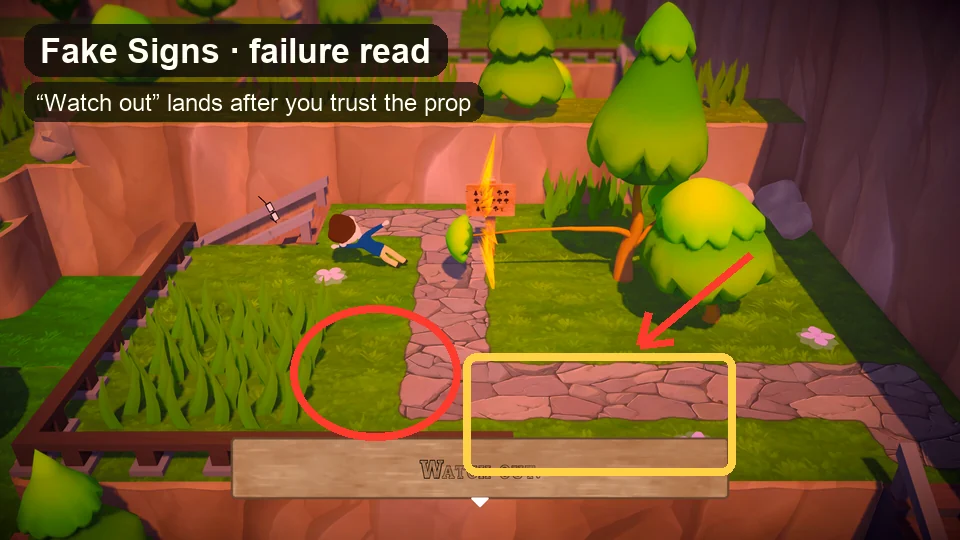 Source frame: official Steam screenshot.
Safe route
Treat every Trees Hate You sign as a warning that the room needs a manual read. Stop before the sign's text box or arrow becomes the center of your screen. Check the space behind the board, the nearest tree, the edge of the path, and the first safe-looking tile after the sign. If two boards disagree, do not average them into a guess. Pick the route with the most recovery room, then move one body-length at a time until the trap shows itself. The fastest safe habit is boring: pause, scan, move, pause again. The sign cluster screenshot is useful because it shows five possible instructions at once, which means none of them should get full trust. In a first run, take the ugly line that keeps you away from the board and gives you a retreat. In a replay, you can tighten the route, but only after you know whether the sign is bait, late truth, or a joke whose only purpose is to make you stand still. One extra check helps: ask what the sign would make a first-time player do if they were embarrassed to slow down. That answer is usually the trap. A board pointing left may be less important than the low fence on the right, because the fence tells you where you cannot dodge after the first tree moves. A board with an axe icon may be pointing at the future solution, not the current safe step. Read the sign as evidence, not authority. Then read the room as the verdict. If the room and the sign disagree, believe the dirt, the fence, and the tree angle before you believe the painted arrow. The arrow is allowed to lie; the collision space is what actually kills you first anyway.
Tips
If you are replaying the Trees Hate You demo for a cleaner route, call out "sign room" before you move. Naming the room breaks the autopilot response, and Fake Signs mostly kill autopilot.
 Source frame:
 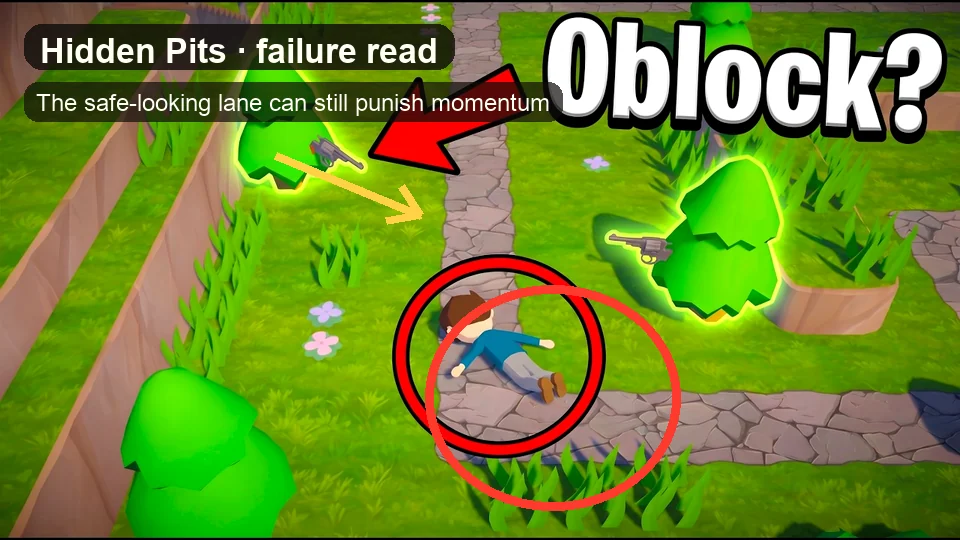 Source frame:
 Trees Hate You traps: Red-Leaf Warnings
Setup
Red-Leaf Warnings are the trickiest Trees Hate You trap family to write about because the public material shows more "warm danger color" than literal red-leaf closeups. The official Steam screenshots still give the useful read: orange-yellow tree crowns, darker leaf beds, mushrooms, and warmer ground patches pull attention away from the actual route. Treat that color shift as the warning family. It says the room is no longer just green forest; something in this patch wants a slower read. New players often do the first half correctly and still die. They notice the colored warning, avoid the obvious colored patch, and then step onto the cleanest-looking detour because it feels like the sensible answer. Trees Hate You uses that sensible answer against you. The color is not the solution. It is the sign that the solution has moved one layer deeper.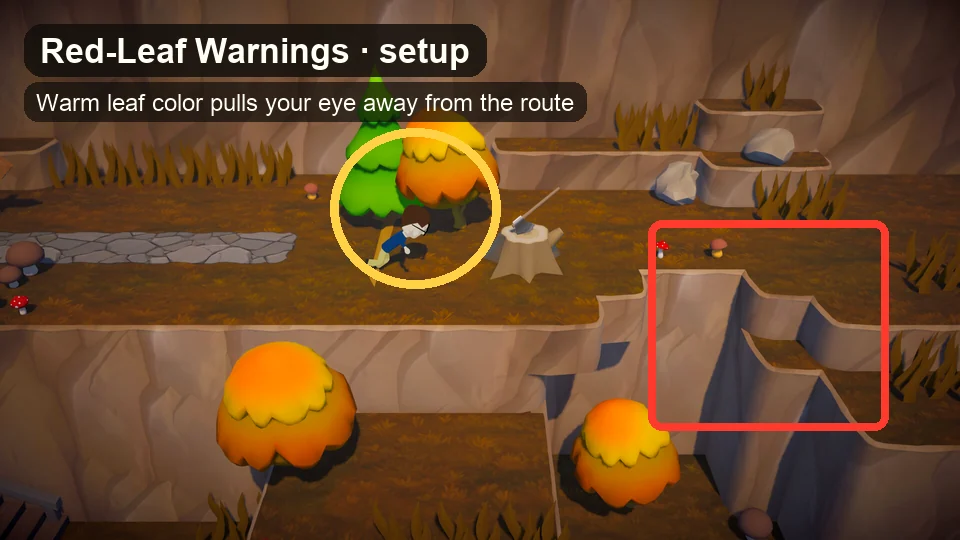 Source frame: official Steam screenshot.
Failure read
Most Trees Hate You Red-Leaf deaths come from over-correcting away from the warning. Once the colored tree or leaf bed grabs your eye, the game expects you to choose the opposite side too quickly. That opposite side is where the second-layer trap often lives: a narrow ledge, a gun-tree angle, a path that looks clear but points your back toward the next attack. That is the practical Red-Leaf pattern. The first warning is loud enough to make you react. The actual survival read is quieter: where do you land after avoiding it, and what can hit that landing spot?
Safe route
Read a Trees Hate You Red-Leaf Warning in two passes. First, identify the colored danger cue and do not stand on the obvious bait. Second, ignore the color for a moment and inspect the "safe" side with the same suspicion you would bring to a Hidden Pit. Is the landing narrow? Is the path forcing your back to a tree? Does the detour remove your retreat? If yes, the real safe route is usually a third line: a short wait, a tighter jump, or a route that passes closer to the warning than feels comfortable. This family matters because it catches the "I saw the warning, so I must be safe now" reflex. Do not trade trust for panic. The forest wants both. Calm reading beats both. If you die here, do not mash restart immediately. Name which layer killed you: the colored cue itself, or the clean detour after it. That one sentence turns the next attempt into practice instead of another coin flip. The safest players almost look indecisive around this family, and that is the point. They let the warning do its first job, then refuse to let it hurry the second choice. If the warm patch is on the main path, check whether the side path is too narrow. If the warm tree blocks the left side, check whether the right side turns your back to a gun tree. If both obvious answers look wrong, wait and look for the less pretty move: a short hop over the edge of the warning, a step back to bait movement, or a route that hugs the wall until the tree commits. Red-Leaf Warnings reward patience that looks silly for one second and smart after the trap fires. The game is counting on the color to make you flinch. Your job is to notice the flinch, wait it out, and only move when the second layer has a clear name.
Tips
If the warm-color read feels uncertain, pause longer than feels natural. The room is not timing you; your own hurry is. Red-Leaf Warnings are easiest when you let the first reaction cool down before choosing a line.
Why Trees Hate You traps repeat
Why do Trees Hate You traps repeat? It's not laziness, it's the central design loop. The first time you see a Fake Sign, you trust the painted arrow and die. The second time, the sign looks identical but the geometry around it has rotated; the safe route is now the path the arrow seems to warn against. Trees Hate You uses repetition the way a comic uses a callback gag — the joke lands harder when you spot the pattern. This is also why the game rewards walking over running. At a jog you only see surface (arrow points right, go right) and speed becomes a weapon against you. At a walk you read the family signature and route past the bait.
Coming soon: Steam-exclusive Trees Hate You traps
The 2026 Steam release of Trees Hate You is promising a second biome and at least two trap families we haven't seen in any public build yet. Falling Tree Triggers got teased in the June 2025 trailer and are partly live in Demo v17, but the full family isn't here yet. When tykenn drops Trees Hate You Steam previews we'll add each new family as its own H2 section with the same setup / failure-read / safe-route breakdown. Watch the itch devlog and the Steam news posts if you want the signal early.